Braiding and fusing anyons gives a full gate set on 54 qubits
Non-Abelian anyons could let a quantum computer skip its most expensive ingredient. A collaboration led by UChicago and Quantinuum has now shown the full set of moves on real hardware.
Error correction is expensive, and one ingredient is the worst
The usual route to a reliable quantum computer is error correction: many physical qubits acting as one protected logical qubit. In the standard schemes, most gates are cheap, but one kind, the gate that makes a computer more than a classical machine can fake, needs special resource states called magic states. Making clean ones by distillation or cultivation takes up a large share of the machine. A different route that avoids this has been proposed for years: store information in the global pattern of a topological state and compute by moving its particle-like excitations around.
What anyons are, in plain words
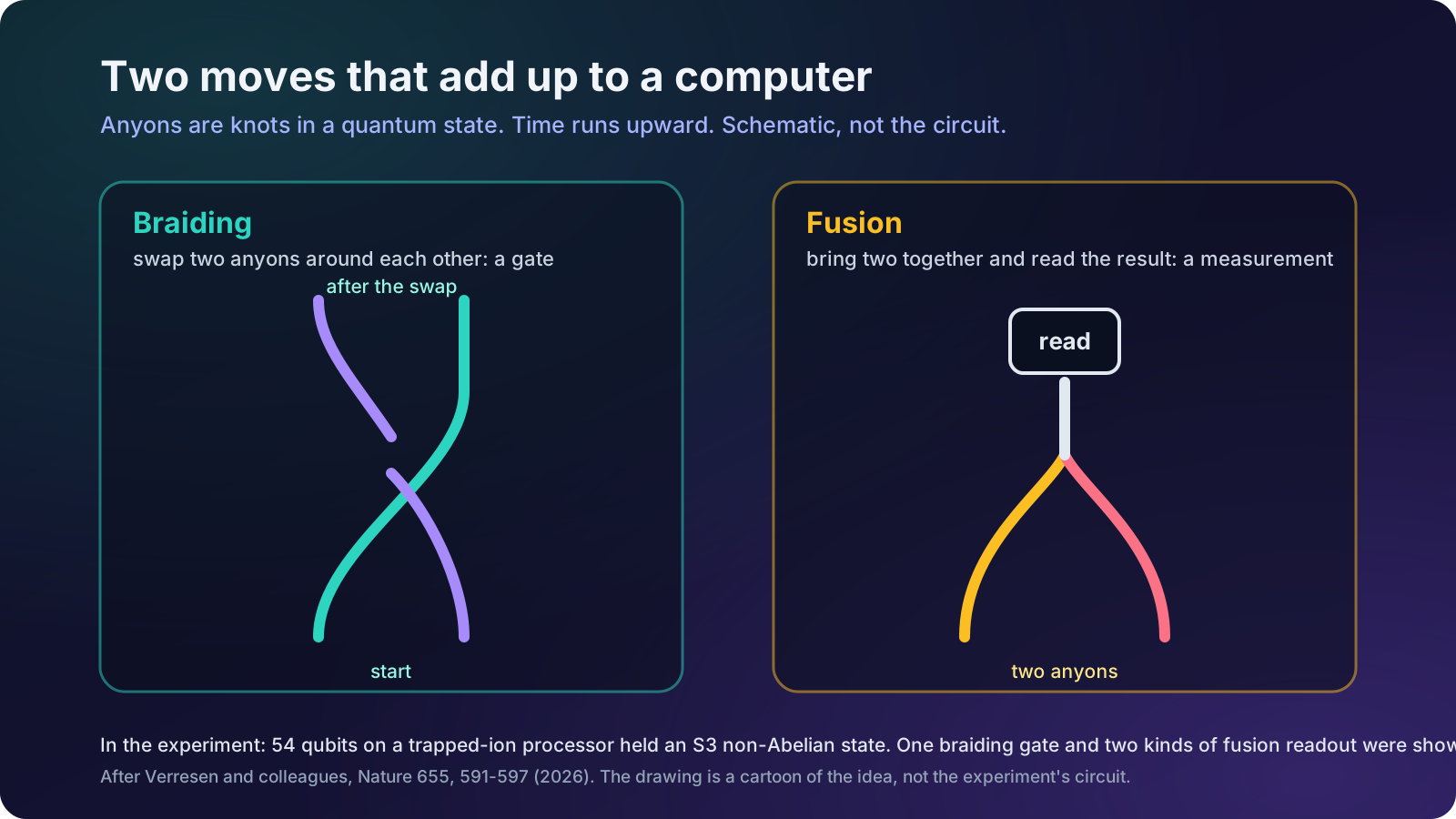
In three dimensions, swapping two identical particles does nothing you can detect beyond a sign. In a flat, two-dimensional system, quasi-particles called anyons can remember how they were swapped. For the kind used here, non-Abelian anyons, the order of swaps matters, the way rotating a book about two different axes gives different results in different orders. Dragging anyons around each other, called braiding, is therefore a computation. Bringing two together and measuring what comes out, called fusion, is another.
The anyons in this experiment are not particles in a material. They are patterns in an entangled state prepared on a quantum computer. The state follows the symmetry group S3, the rotations and reflections of an equilateral triangle, which is the smallest group whose anyons are non-Abelian.
What the team reports
A collaboration of the University of Chicago Pritzker School of Molecular Engineering, Harvard, Stony Brook University and Quantinuum, with Ruben Verresen among the leads, used Quantinuum’s H2 trapped-ion processor. They prepared a 54-qubit state with S3 non-Abelian topological order, and then showed three operations: one entangling gate made by braiding, and two kinds of measurement made by fusion. Together, the paper reports, these form a universal gate set. As a demonstration, they prepared a magic state topologically. The paper is Universal gates from braiding and fusing anyons on quantum hardware, Nature 655, 591 to 597 (2026).
The point they make is that, in principle, a computation in this code would not need the costly magic-state distillation. That is a statement about the design. It is not a measured saving.
What the figure shows
The figure at the top is a cartoon of the two moves, with time running upward. On the left, two strands swap places, which is the braid. On the right, two strands meet and merge, and the result is read out, which is the fusion. It is our drawing of the idea. It is not the circuit and it carries no data.
What this does not show
- There is no active error correction. Verresen calls it
more like a proof of principle
. The protection that makes topological computing attractive is the promise, and this demonstration does not run it against errors. - The anyons live inside a quantum computer. They are patterns in a state prepared on 54 qubits of a working trapped-ion machine, not excitations of a material. That is different from building a topological qubit in a device.
- “Universal” is about the gate set. It means the set of operations is enough, in theory, to run any quantum algorithm. It does not mean the machine can run one at scale.
- We have not seen the fidelities. The abstract and coverage we could read do not give the error rates of each operation, so we do not quote any.
Why a reader of this site should care
The cost of a logical qubit is the number that decides how big a useful machine has to be, and magic states are a large part of that cost. A route that produces them as a natural by-product of the code would change the arithmetic. This paper is a first experimental step that the route is reachable. Whether it ever beats the standard schemes is a question for much larger machines than 54 qubits.
Sources
- "Universal gates from braiding and fusing anyons on quantum hardware", Nature 655, 591-597 (2026), doi:10.1038/s41586-026-10709-y
- ScienceDaily, "Quantum computing's dark horse just proved it can go universal"
- Lo, Lyons, Verresen, Vishwanath and Tantivasadakarn, "Universal quantum computation with the S3 quantum double: a pedagogical exposition", arXiv:2502.14974
We read the sources above ourselves. Where a figure or number is ours, the article says so. If you find a mistake, tell us: a wrong sentence here gets logged like any other.
More from the research desk
- Watching a single phonon jump: the first quantum jumps of sound Stanford University
- Sound waves keep a diamond qubit coherent three times longer Harvard SEAS
- Bosonic-code gates in one driving period instead of thousands Chalmers University of Technology
- A flip at the right moment can stop entanglement from dying Raman Research Institute
- Entanglement over 10 km of fibre that lasts longer than it takes to make University of Science and Technology of China
- Splitting one error-corrected qubit into two entangled ones ETH Zurich
- Every paper on the desk