Splitting one error-corrected qubit into two entangled ones
Lattice surgery is how error-corrected qubits will be made to interact without ever being left unprotected. ETH Zurich has done the basic move on superconducting hardware.
Protected qubits still have to talk to each other
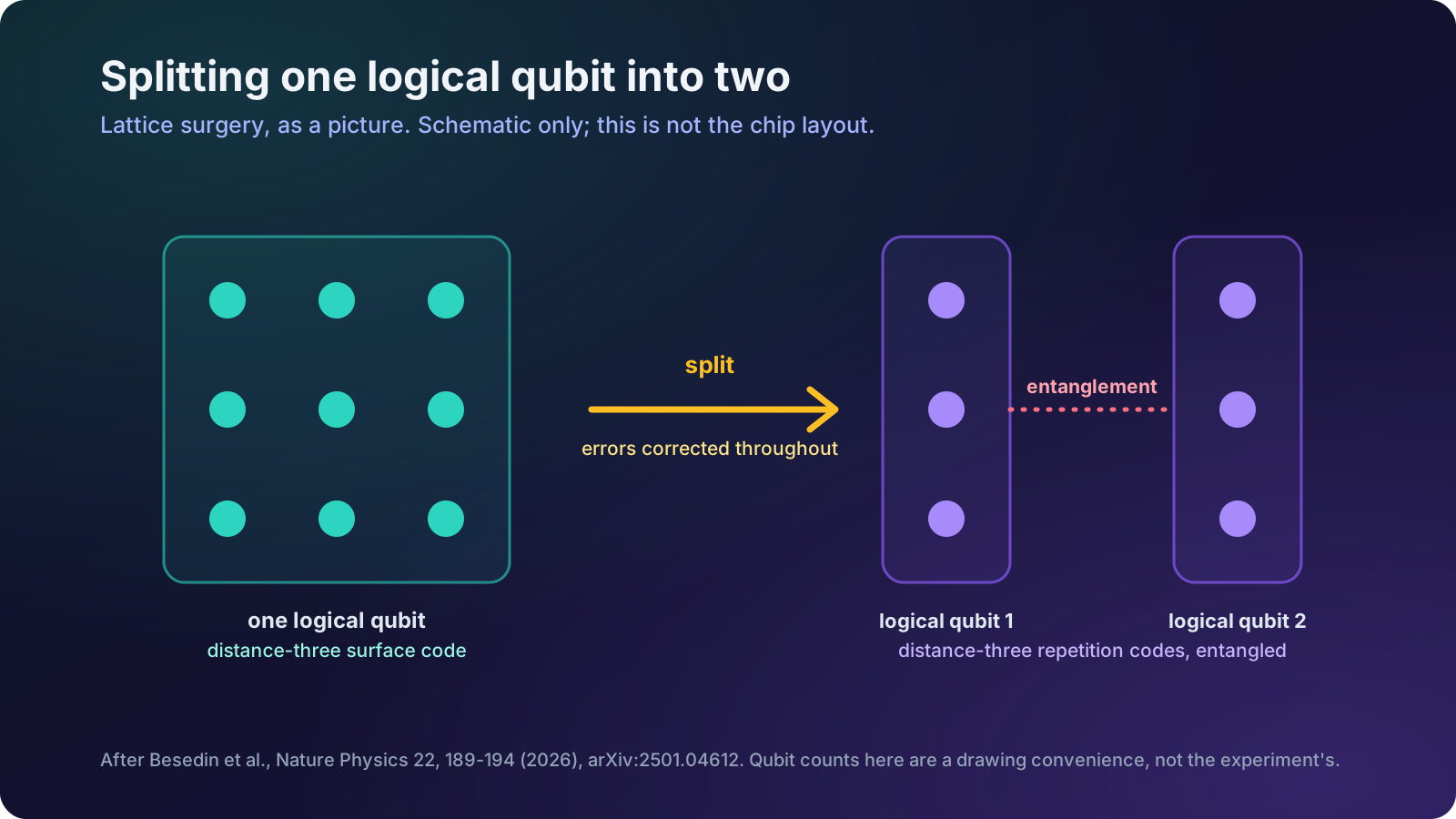
An error-corrected qubit is a logical qubit: many physical qubits acting as one, with errors found and repaired all the time. That protection is only useful if two logical qubits can be made to interact. The obvious way, wiring them together and applying a gate, risks exposing them while they do it. Lattice surgery is the approach designed for the surface code: instead of moving qubits around, you change which qubits the checks are measured over, merging two patches into one or splitting one into two. Errors keep being corrected the whole time.
What ETH Zurich reports
A team led by Ilya Besedin, Michael Kerschbaum and Andreas Wallraff at ETH Zurich, with theorists including Markus Müller, reports a lattice-surgery operation on superconducting qubits: splitting one logical qubit stored in a distance-three surface code into two logical qubits, each stored in a distance-three repetition code. The split entangles the two. They built the circuit so that it is fault-tolerant against bit-flip errors, and measured an improvement in a two-qubit logical quantity, the decoded ZZ correlation, compared with the same circuit run without any encoding. They also characterised the operation by logical two-qubit tomography.
It appeared in Nature Physics 22, 189 to 194 (2026), and on arXiv as 2501.04612 in January 2025. The abstract describes it as laying out the building blocks for lattice surgery on larger-distance codes with superconducting circuits.
What this does not show
- It protects against one kind of error. The circuit is fault-tolerant for bit flips. Phase flips are not covered, and a full quantum computer has to handle both. That is why the target is described as a building block.
- Distance three is small. At distance three the code corrects a single error. The case for error correction is made at larger distances, where each step makes the logical error rate fall further. See the threshold explorer for why.
- One operation. A split is one of several moves a lattice-surgery machine needs. Merging, repeated rounds and running real algorithms on top are the work that follows.
- “Improvement” is relative to no encoding. The comparison is with the same logic done on bare qubits. It shows that encoding helped on this measurement, which is the right first test.
Why it matters
Most headlines about error correction are about memory: keeping one logical qubit alive for longer. Computation needs the harder half, making protected qubits act on each other. This is a small, honest step on that half, on the same family of hardware as the chips discussed on our race page.
Sources
- Besedin et al., "Realizing lattice surgery on two distance-three repetition codes with superconducting qubits", Nature Physics 22, 189-194 (2026), arXiv:2501.04612
- Nature Physics page, doi:10.1038/s41567-025-03090-6
- Fowler et al., "Surface codes: towards practical large-scale quantum computation", arXiv:1208.0928
We read the sources above ourselves. Where a figure or number is ours, the article says so. If you find a mistake, tell us: a wrong sentence here gets logged like any other.
More from the research desk
- Watching a single phonon jump: the first quantum jumps of sound Stanford University
- Sound waves keep a diamond qubit coherent three times longer Harvard SEAS
- Braiding and fusing anyons gives a full gate set on 54 qubits UChicago, Harvard, Stony Brook and Quantinuum
- Bosonic-code gates in one driving period instead of thousands Chalmers University of Technology
- A flip at the right moment can stop entanglement from dying Raman Research Institute
- Entanglement over 10 km of fibre that lasts longer than it takes to make University of Science and Technology of China
- Every paper on the desk